AI Plan Check Workflows for Zoning and Code Compliance
Four review stages show which code checks software can automate and which need a licensed reviewer.
AI plan check workflows for zoning and code compliance work best as a structured review sequence. The sequence extracts controlling requirements, cross-references drawings, flags exceptions with citations, and routes judgment calls to a licensed reviewer. Understanding those stages lets firms automate repeatable checks without confusing software findings with professional determinations.
Why zoning and code plan checks fail before they reach a reviewer
Manual zoning review breaks down because its information is fragmented across systems never designed to work together. The ordinance text is on a municipal website, while the project drawings are in Procore or Autodesk Construction Cloud. Reconciling them requires repeated movement between highlighted PDFs and drawing sheets. A requirement can be understood correctly yet checked against the wrong sheet or overlooked when its controlling exception appears elsewhere.
Code currency adds another layer of uncertainty. The National Zoning Atlas has identified thousands of zoning jurisdictions across the United States, each updating on its own schedule. A team can therefore complete an otherwise clean review against a superseded ordinance. A missed setback dimension or an overlay trigger buried in a subsection may remain invisible until municipal plan review. By then, correction can require redesign and a full resubmittal cycle.
What a zoning compliance review actually checks, item by item
The first pass establishes whether the proposal satisfies the district’s base use and dimensional standards. Land use classification comes first. The proposed use must be permitted in the mapped district, whether C-2, M-1, MX, or another designation. Setback review then checks the front, rear, and side yards one by one, comparing what is required with what is provided. Height and FAR checks use the currently adopted ordinance rather than a handbook, because amendments can change FAR limits and rules for height-setback interaction can change the result.
Parking requires more than a stall count. Layout, queuing lanes, and bicycle spaces each need their own check, while signage limits are usually in a separate ordinance article. The second pass examines conditions that change the approval path even when the base standards are satisfied. Historic overlays may require a certificate of appropriateness before the governing body. FEMA flood zones, coastal zones, view corridors, and commercial overlays can introduce further restrictions, including FAR limits that vary with the underlying residential district.
Relief from setback, height, or lot coverage limits introduces variance questions. Conditional use requires a different approval path. A CUP is granted at discretion rather than as a matter of right, so identifying that trigger early changes the permitting timeline. Beyond zoning, a full plan check reaches egress widths, stair geometry, occupancy and construction-type classification, ADA/accessibility clearances, fire and life safety, MEP coordination, and energy compliance. Each verification connects a particular standard to evidence on a particular sheet.
The four-stage sequence AI plan check workflows follow
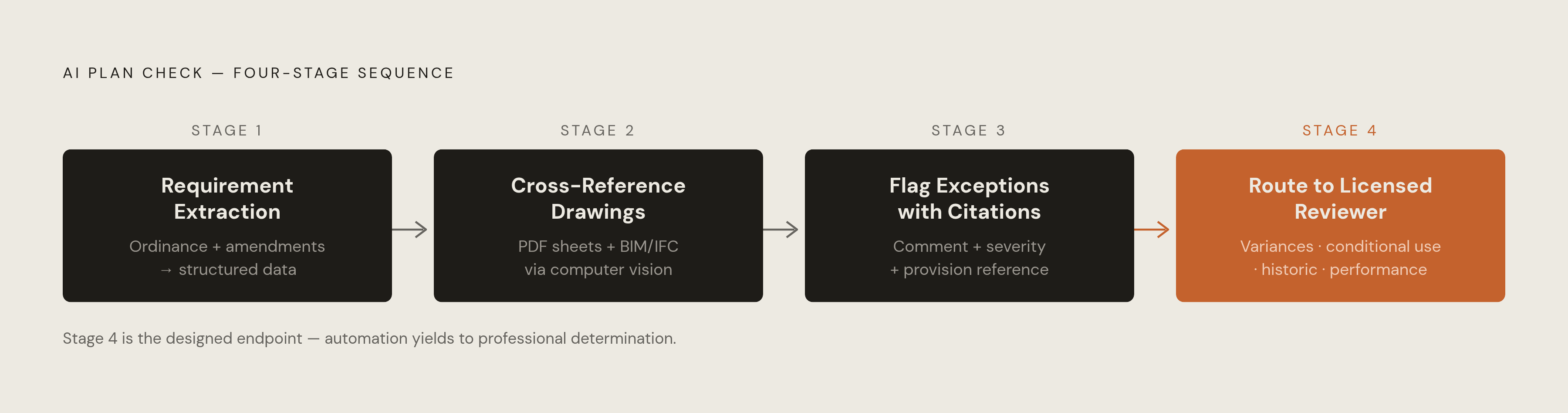
Stage 1 is requirement extraction. The system reads the adopted ordinance, local amendments, and overlay language, then puts the controlling requirements into structured data. Exceptions and cross-references make this difficult. A curated rules library and an LLM that reads code text directly can each make different kinds of errors. A hybrid architecture uses the LLM for interpretation and a symbolic engine for enforcement, constraining conclusions to the encoded logic. Versioned, curated libraries are therefore more defensible for covered provisions than reliance solely on an LLM reading PDFs at inference time.
Stage 2 is cross-referencing drawings. The system matches the requirements it has extracted to elements in PDF sheets, BIM/IFC models, or both. For 2D drawings, computer vision detects walls, doors, dimensions, annotations, and sheet references. For BIM/IFC models, object parsing produces a normalized graph of spaces, elements, and relationships for geometric tests. Extraction accuracy constrains every downstream result. A misread corridor width corrupts the egress calculations built on it, regardless of how accurately the applicable rule was encoded.
Stage 3 is flagging exceptions with citations. A non-conforming item receives a comment, severity rating, and reference to the provision that triggered it. Citation makes the finding usable. It gives the reviewer a route to verify or rebut the conclusion rather than treating the flag as an unsupported assertion. Outputs vary from clause-and-page pass/fail findings to reviewer reports and project-management integrations for RFI generation. Tools that compare versions can also match sheets, find changes, and carry the relevant comments forward to help focus the resubmittal review.
Stage 4 is routing judgment calls to a licensed reviewer. Conditions that cannot be resolved algorithmically move into a reviewer’s queue. Routing is a designed outcome. Conditional use triggers, variance requests, historic district interpretations, and performance-based energy compliance belong here. The sequence succeeds when it distinguishes a mechanical comparison from a decision that requires professional judgment.
What current platforms actually cover — and where the boundary is
Automated coverage concentrates on life safety, accessibility, and dimensional zoning, where requirements are comparatively precise and frequently checked. That concentration gives the tools useful work. It does not extend automatically to performance-based energy simulation, structural calculations, ambiguous exceptions, or provisions the vendor has not encoded. A system’s ability to ingest a code document is not the same as complete automated coverage of that code.
The market’s categories reflect these different scopes. Automated code-compliance checkers address prescriptive provisions in IBC, NFPA, ADA, and similar standards, while zoning-analysis engines assess FAR, setbacks, and use permissions before massing is locked. Accessibility checkers focus on ICC A117.1 and ADA, often through BIM plugins. Energy and carbon analyzers handle prescriptive-path reporting and increasingly embodied carbon. QA/QC assistants examine missing details, drawing coordination errors, and cross-discipline inconsistencies.
The approval boundary is separate from technical coverage. None of the jurisdictions represented in the supplied sources accepts AI output as a substitute for professional review or AHJ approval. Florida’s House Bill 683 (2025) explicitly authorizes licensed private providers to use automated or software-based systems for single-trade plan review code compliance. Software still serves as a pre-check filter in a review process that professionals control.
How the tools on the market divide by input, output, and jurisdiction
UptoCode accepts PDF drawing sets and IFC/BIM models natively, supports multiple drawing sets per project, and offers a screenshot tool for querying details. Its findings cite the specific clause and drawing or model element. Its stated scope includes any uploaded regulation, including NCC, IBC, Eurocodes, AS/NZS, and custom QA guidelines, with a strong fit for Australian NCC work and BIM-heavy teams. Helonic, formerly Articulate, takes a different input approach. It uses 2D PDFs without requiring BIM/IFC and provides a US code library spanning IBC, IRC, NEC, IPC, NFPA, and ADA, built around US permitting workflows including Florida’s software-based review framework.
CodeComply.AI accepts PDF plan sets for review against ICC/IBC-family codes, NFPA 101, ADA, and FHA. It has revision comparison and plan chat, has been through a SOC 2 audit, and serves US building departments, including through CivicPlus’s government workflow. CivCheck, now a Clariti company, also accepts PDFs. Its “Guided AI Plan Review” serves applicants and city staff across zoning, building, fire, accessibility, plumbing, and structural codes. It focuses on US municipalities and AHJs and publishes quantified government-pilot results.
Archidian reviews PDF drawings against IBC, ADA, IPC, IMC, and NFPA standards referenced by code for the US market. UpCodes serves a different review function. Its searchable, cross-referenced US code library and AI copilot support code research and interpretation, but do not check drawings or BIM models against a code. Conflation Labs focuses on site plan review against local zoning codes, setbacks, and municipal standards. Its stated fit is feasibility and schematic work for planners, developers, and architects on residential, multifamily, commercial/office, and mixed-use projects.
Nomic AEC uses AI agents to check drawings against 380+ codes and standards, and each finding cites the section that governs it. Its checklists span architectural, structural, mechanical, plumbing, electrical, civil, fire protection, telecom, and landscape disciplines. Drawing comparison, submittal review against specifications, and RFI research share the same workspace. Its integrations include Forma, Bentley ProjectWise, Trimble ProjectSight, SharePoint, Egnyte, and Fieldwire, with SOC 2 Type II and multi-region hosting. Integration is a selection criterion in its own right, particularly where firms need findings to enter existing CAD, BIM, document, and stamping processes.
Where the documented throughput gains come from
Permittable’s case study shows how one of the largest US homebuilders used its AI Permit Review Diagnostic before submitting plans. The builder’s Washington State division reported that first-round city comments fell from an average of more than 30 per application to an average of three. This is a pre-submittal result. Its significance lies in catching issues before they enter the city’s correction process, where resolving them can require another submission.
On a third or fourth resubmittal, reviewers can lose hours rereading entire sets simply to establish what changed. Matching sheets, finding differences, and carrying comments forward cut down on that repeated reading. The two mechanisms reinforce each other.
What stays human in a compliant AI plan check workflow
The licensed reviewer’s work concentrates where comparison alone cannot establish compliance. Performance-based provisions need simulation or engineering calculation, while discretionary approvals rest on what a reviewing body decides. Ambiguous ordinance language presents another kind of judgment. Where two reasonable interpretations exist, a reviewer must develop and argue a position to the AHJ.
Incomplete evidence also requires human attention. Renovation and adaptive reuse documentation may be inconsistent or incomplete, degrading extraction accuracy before any rule is applied. Cross-jurisdictional overlay interactions can likewise fall outside the encoded library. In these cases, the reviewer must address the evidence or interpretation. Good routing brings those questions to the reviewer after mechanical violations have been resolved, so the licensed reviewer can focus on the decisions most likely to shape the project.
For firms, the practical safeguard is a designed review and stamping step, with a licensed engineer reviewing and approving every AI-produced deliverable. That step preserves a clear accountability chain. Treating software output as a final compliance determination instead exposes the firm to liability. The reviewer is not being automated away, but repositioned from repeated arithmetic toward the provisions that require a licensed opinion.
How to adopt an AI plan check workflow inside a firm without stalling
An AI champion or coordinator connects technology decisions to actual review work and owns the rollout beyond the pilot. The initial scope should be one project type or review stage where the mechanical check is clearest, such as setbacks and dimensional zoning. A demonstrated cycle-time reduction then supports expansion. Without defined success and a sequence that builds confidence, adoption can stall even when the technology performs.
Staff involvement makes that sequence more workable. Participation in evaluation, selection, and piloting addresses the people and process changes that a software purchase alone cannot resolve. Leadership training helps principals and project managers build critical-thinking and change-management skills so they can put the tools to work in line with the firm’s strategy. Training in ethics teaches staff about bias, accuracy, privacy, and security. Those subjects matter especially when project information must stay private to the firm and be excluded from external AI training sets.
The phased roadmap allows time for implementation and oversight. An execute-pilot phase runs roughly through months 2–6, as the firm prepares data, puts the tools to work, and carries out human-in-the-loop review. A scale phase follows through months 6–18, extending into multiple workflows, governance, and training. Working inside existing tools such as Civil 3D, Revit, and Bluebeam makes onboarding easier because findings enter established approval processes. The strategic measure is project throughput and revenue per person. Recovered review capacity creates value when the firm can use it to take on the next project.